
Family-Owned, Licensed and Insured, Serving Fountain Hills Since 2015

Commercial Pressure Washing in Fountain Hills, AZ

Your Fountain Hills property sits in one of Arizona’s most image-conscious communities. The Avenue of the Fountains, Fountain Park, the public art installations, the carefully maintained streetscapes: every detail in this town signals to residents, visitors, and prospective tenants that standards here are higher than the surrounding desert. But the same environment that makes Fountain Hills distinctive also works against your building every single day. Fine Sonoran dust settles into recessed stucco details. UV oxidation bleaches facade paint to a chalky white film. Late-summer monsoons drive mineral-laden runoff across walkway concrete and leave tide lines that don’t wash away with the next rain. AZ Power Clean was built around exactly this problem, helping commercial property managers in desert climates maintain exteriors that match the communities their buildings anchor.
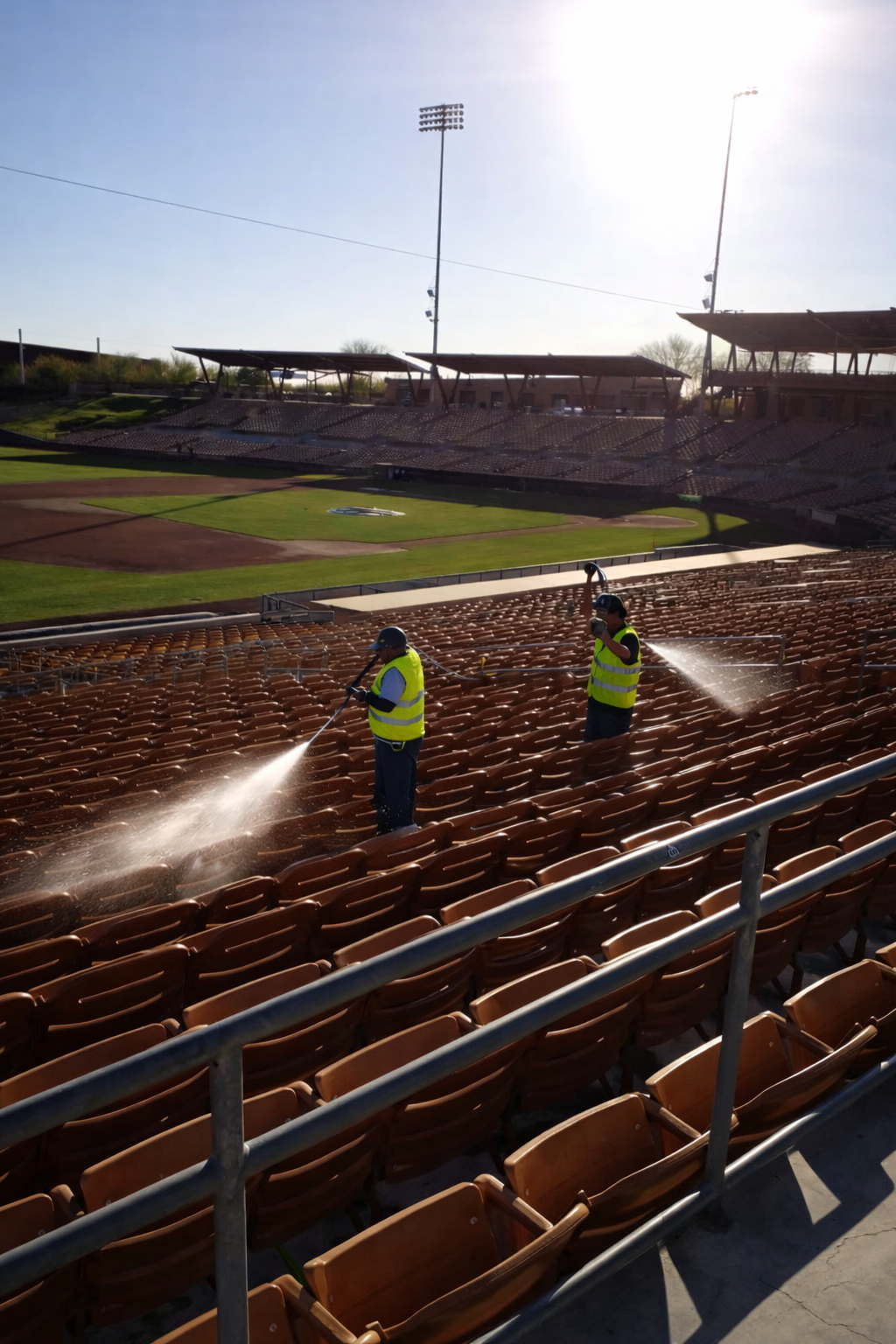
Hot-water pressure washing a Fountain Hills commercial stucco facade with UV oxidation bloom and post-monsoon mineral tide lines

FOUNTAIN HILLS CLIMATE REALITY

Why Fountain Hills Commercial Properties Face a Harder Cleaning Challenge Than Most

Fountain Hills sits at 1,520 feet of elevation, and that detail matters more than most property managers realize when they are trying to understand why their building looks dirtier faster than they expect.

At Fountain Hills’ elevation, wind patterns off the surrounding ridgelines push fine PM10 particulate matter across horizontal surfaces, into window tracks, and deep into recessed facade details in ways that flat-valley properties rarely experience. The town actively monitors and reports PM10 levels to state regulators under its own dust control program, which tells you something about how seriously this problem accumulates.
UV exposure at this elevation accelerates oxidation on stucco and painted concrete faster than lower-altitude desert properties. That chalky white bloom appearing on your upper facade is not just cosmetic. To the affluent, detail-sensitive customers and tenants that Fountain Hills businesses depend on, it reads as neglect.
The hard, fast rains of late summer carry suspended dust and mineral particulate directly into porous building surfaces. When that water dries on walkway concrete, it leaves mineral tide lines that standard cleaning cannot touch. Organic debris banks against building bases and stays there.

The cost of letting this compound is not abstract here. A storefront that looks dirty against the backdrop of Fountain Hills’ public art installations and manicured park district is a storefront that loses the first impression permanently, and this is not a market where customers lower their expectations.

BUILT FOR THE DESERT, BROUGHT TO FOUNTAIN HILLS

A Family Business Built Around Desert-Climate Cleaning Expertise

The company behind this work was not built as a general cleaning business that happens to serve Arizona. It was built around the specific cleaning demands of the desert environment, and has been family-operated since 2015. That distinction matters when you are managing a Fountain Hills commercial property because desert-climate cleaning expertise is not transferable from general commercial washing.

The mineral content of water available in this part of Arizona, combined with the UV oxidation rate at Fountain Hills’ elevation, requires different pressure calibrations and dwell times than flat-valley properties. Pushing the same pressure settings used on a low-elevation concrete plaza into a Fountain Hills stucco facade does not produce the same result. It produces etching, surface micro-fractures, and paint lift from trim bands, problems that cost significantly more to repair than the cleaning job itself.

What 15 years of Arizona field experience produces is the kind of pattern recognition that only comes from working on hundreds of stucco facades, desert stone accent features, and monsoon-damaged concrete surfaces: knowing when soft-wash technique is the answer, when dwelling time matters more than pressure, and when the cleaning agent chemistry needs to change for the specific mineral content left by this town’s water.

Every commercial property the team works on is approached as if the outcome reflects directly on the people doing the work. That is not a philosophy statement. It shows up in how surfaces are assessed before a single nozzle is turned on.
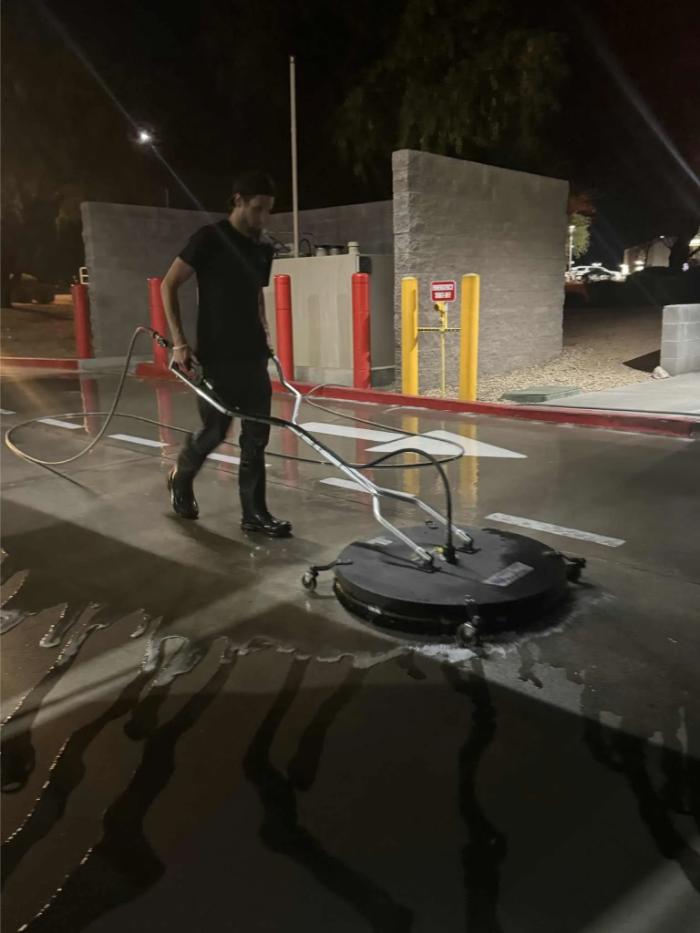
AZ Power Clean family-owned crew servicing a Fountain Hills commercial property

FOUNTAIN HILLS COMMERCIAL EXTERIOR CLEANING

Commercial Exterior Cleaning Services for Fountain Hills Properties

If you manage a commercial property in Fountain Hills, you are responsible for surfaces that age at different rates under the same desert conditions. The stucco facade absorbs UV differently than the parking lot concrete directly below it. The covered entry canopy develops moisture and biological growth in its shadow zone while the sun-facing facade above it oxidizes and chalks. The dumpster enclosure behind the building accumulates grease and organic debris on a completely different schedule than the storefront glass facing the street. Chasing three separate contractors to cover all of this creates scheduling gaps, inconsistent standards, and the recurring problem of one vendor’s work looking noticeably different from another’s. The sections below cover how each major surface type is handled as part of a single, coordinated vendor relationship.

Building Washing

Stucco and painted CMU building exteriors in Fountain Hills typically develop what looks like a two-zone contamination problem. The upper facade sections, fully exposed to year-round UV, develop a dull chalky oxidation film that signals aging to anyone approaching the property. The lower building base, sitting in the monsoon splash zone, collects suspended mineral particulate and organic debris that bakes into the surface as soon as the sun returns. Both zones require cleaning, but they do not require the same approach. High pressure on oxidized upper stucco does not remove the chalky film, it drives particulate deeper into the surface or strips the paint from trim bands. Soft-wash technique, using appropriate dwell times and the right cleaning chemistry for this specific mineral environment, lifts oxidation from the upper facade without etching the stucco. The lower monsoon zone responds better to controlled pressure calibrated to the surface density of the specific CMU or stucco mix. The result is a facade that reads as maintained and cared for, which in this market is not a cosmetic goal, it is a tenant-retention and customer-acquisition argument.

Concrete Cleaning

Fountain Hills’ commercial concrete surfaces accumulate three distinct stain types, and each one requires a different response. Monsoon-season runoff leaves mineral tide-line deposits on walkway concrete that look permanent because, without professional cleaning agents matched to their mineral composition, they largely are. Oil drip and tire-transfer staining on parking lot surfaces sets faster at desert temperatures than in cooler climates because the heat drives the compounds deeper into the concrete matrix before evaporation occurs. And foot traffic entry areas along corridors like Palisades Boulevard and Saguaro Boulevard develop worn, ground-in grime patterns that general hosing does not lift. Professional concrete cleaning addresses all three of these stain categories with targeted chemistry and appropriate pressure rather than generic surface restoration. The practical outcome for a property manager is a parking lot and walkway that no longer sends a message of deferred maintenance to every customer or tenant walking the property. In a town where the public streetscape and park areas are kept at a specific visual standard, a commercial parking lot that looks like it belongs to a different city is a competitive liability.

Pressure Washing

The secondary surfaces on a Fountain Hills commercial property, dumpster enclosures, loading dock aprons, covered walkways, equipment staging areas, all collect grease, organic debris, and monsoon-deposited dust on the same schedule as the building face. The difference is that nobody schedules them until a tenant complains or a health inspector flags them. By that point, the organic debris has been cooking in desert heat long enough that it is not coming off with a garden hose. A professional pressure washing crew treats these secondary hardscape surfaces as part of the property’s overall maintenance schedule, not as a reactive fix. Keeping dumpster enclosures and service areas clean also matters in Fountain Hills specifically because the town’s environmental compliance programs around runoff and PM10 control apply to commercial properties, and accumulated organic waste and uncontained wash runoff can draw scrutiny from code enforcement even before a tenant raises a concern.

NEIGHBORHOODS & COMMERCIAL DISTRICTS

Pressure Washing Across Fountain Hills Neighborhoods and Commercial Districts

Fountain Hills concentrates its commercial square footage in identifiable districts, and those districts do not share the same surface conditions, building ages, tenant mixes, or foot traffic volumes. A single cleaning protocol that works at a downtown storefront does not apply unchanged to a light industrial bay on Saguaro Boulevard. The property manager who oversees buildings in more than one of these areas will recognize the specific environment described in each section below.
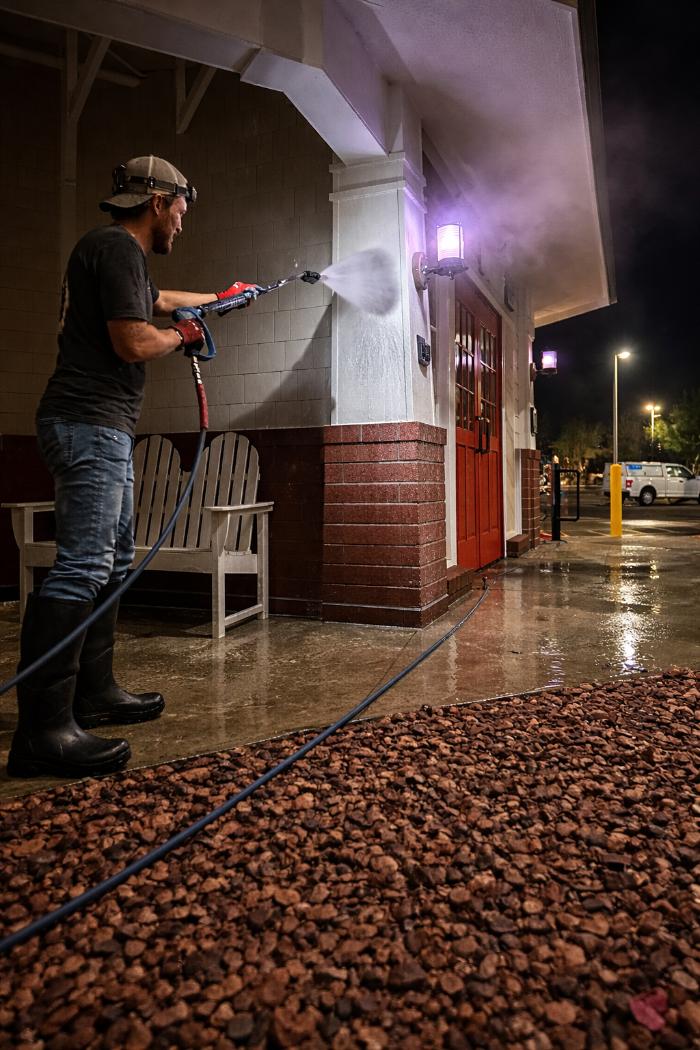
The Avenue of the Fountains corridor is Fountain Hills’ most visible commercial address, and the physical environment there creates cleaning conditions that are unlike any other part of town. The eight fountain structures generate constant mist in the surrounding air, and that mist deposits a fine mineral film on every horizontal surface within the adjacent commercial blocks. Decorative concrete plazas, covered storefronts, outdoor seating areas, and entry walkways all collect this film continuously, not seasonally.

On top of the mineral mist load, the Avenue’s programming calendar brings event setup and teardown across the plaza areas throughout the year. Tent stake points, equipment staging, vendor traffic, and elevated foot counts during art walks and festivals leave scuff marks, staining, and compressed debris in concrete surfaces that do not self-correct between events.

For a property owner or manager whose storefront or office fronts directly onto this corridor, the visual stakes are acute. The town has invested heavily in its Downtown Overlay District strategy, positioning this area as a premium arts and retail destination. A building exterior that reads as neglected against that backdrop does not just reflect on one business, it signals a gap between the district’s ambitions and the property’s upkeep. Regular cleaning scheduled around event cycles keeps facades, walkway surfaces, and plaza areas consistent with the standard the district is actively trying to project.

The Palisades Boulevard corridor concentrates some of Fountain Hills’ largest commercial footprints: the anchor retail center at Palisades and Saguaro (132,192 square feet), the medical office and urgent care facilities at Palisades and La Montana including the HonorHealth location, and the professional office suites serving the town’s financial services and healthcare economy. Property managers here are responsible for surfaces that are assessed by patients, medical professionals, and professional services clients, audiences who arrive with expectations calibrated to healthcare and professional environments.

The cleaning priorities at these properties are specific. Drive-lane and parking lot concrete carries the heaviest tire-transfer and oil drip load in town, and at desert temperatures that staining sets quickly and deeply. Entry facades and covered walkway canopies directly in front of medical and professional office suites are evaluated by patients and clients in the three to five seconds before they reach the front door. A canopy that shows biological growth in its shadow zone or a walkway with embedded oil staining at the entry pad creates a first impression that no interior renovation budget can fix.

Scheduling professional concrete and facade cleaning on a regular cycle, rather than waiting for the surfaces to degrade visibly, is how property managers at Palisades corridor properties keep their tenant base from receiving complaints about building presentation. It is also how they maintain the leverage to attract replacement tenants who are comparison-shopping across facilities.

The commercial cluster anchored by Eagle Mountain Village Plaza (82,712 square feet) serves a specific function in the town’s commercial geography: it is where residents coming into Fountain Hills often stop first, and it is the commercial face of the town for anyone arriving from the Shea Boulevard approach. High drive-by and drive-through traffic volumes mean its parking lot concrete and entry pad surfaces accumulate tire marks, oil staining, and food-service grease at a faster rate than commercial properties deeper in the town’s interior.

That high-volume traffic load also means the property manager here has less margin for error on exterior presentation than counterparts at lower-traffic locations. A resident who passes this center twice a day notices when the parking lot looks stained, when the entry canopy is visibly soiled, or when the concrete pads in front of food-service tenants carry grease transfer marks from vendor deliveries. In a market where residents have strong civic pride in how their town looks, a gateway property that reads as poorly maintained creates friction that is felt well beyond the immediate tenants.

Frequent concrete cleaning cycles (especially targeting the food-service adjacent surfaces and drive-lane entry areas) combined with regular facade washing keeps Eagle Mountain Village at the standard incoming residents and visitors expect from the first commercial property they see when they arrive in Fountain Hills.

The commercial and light industrial properties along Saguaro Boulevard between Colony and Enterprise Drives represent Fountain Hills’ industrial-zoned acreage, and the cleaning conditions here are meaningfully different from the retail and medical corridors. Loading dock aprons accumulate fuel and hydraulic fluid transfer from delivery and service vehicles. Exterior wall surfaces collect diesel exhaust particulate and windblown dust from the surrounding open desert at a pace that visible accumulation becomes significant within a single season. Dumpster enclosures and equipment staging areas build up organic waste and grease residue that, in Fountain Hills’ heat, creates odor and pest-attraction problems alongside the visual maintenance issue.

Property managers in this corridor also frequently operate under tenant lease terms that include exterior maintenance obligations, meaning deferred pressure washing can become a lease compliance issue, not just an aesthetic one. The town’s environmental compliance programs around PM10 control and surface runoff apply here as they do elsewhere in Fountain Hills, and industrial properties with uncontained wash runoff or excessive particulate accumulation on exposed surfaces are more visible to code enforcement than properties in the commercial districts.

Scheduling regular pressure washing of dock aprons, wall surfaces, and enclosure areas, with proper on-site wastewater containment, keeps these properties compliant, functional, and within the terms of the tenant agreements they are legally required to honor.

AZ Power Clean crew servicing a Fountain Hills commercial property and the surrounding metro service area

COVERAGE AREA

Serving Commercial Properties Beyond Fountain Hills

Many property managers in Fountain Hills also oversee buildings in surrounding suburbs or hold portfolios that extend across the broader service area. Managing exterior cleaning across multiple properties in different communities creates a coordination problem when each location is handled by a different vendor with different scheduling systems, different quality standards, and different pricing structures.

A single vendor relationship that travels with the portfolio solves that problem. The crew already understands the desert-climate surface conditions common across the broader region, which means the assessment, calibration, and cleaning approach does not need to be reinvented for each property. Scheduling across multiple sites can be coordinated as a single conversation rather than four separate calls. Consistent cleaning standards across all properties means a property manager is not explaining to an ownership group why one building looks better than another.

For portfolios that extend into neighboring communities or across the broader service area, the practical value is one relationship, one standard, and one point of accountability for the condition of every exterior the team touches.

COMMON QUESTIONS

Frequently Asked Questions About Commercial Pressure Washing in Fountain Hills

The most practical anchor point for Fountain Hills properties is post-monsoon, typically September, when the season’s heaviest deposit of dust and mineral particulate has finished accumulating. A second cleaning cycle before peak UV season, in the spring, addresses oxidation and winter buildup before the intense summer sun locks surface contaminants in more deeply. High-traffic properties along the Avenue of the Fountains or Palisades corridor may benefit from quarterly scheduling given their continuous foot traffic and, in the downtown case, fountain mist exposure.
Fountain Hills participates in state surface pollution reduction requirements, and commercial properties are expected to manage wastewater generated during exterior cleaning so it does not enter stormwater drainage systems untreated. A professional crew addresses this by containing wash water on-site using berms, wet vacuums, or collection systems appropriate to the site layout, then disposing of captured wastewater through compliant channels. This is not optional protocol, it is how responsible commercial pressure washing operates in a town with an active environmental compliance program, and it is what distinguishes a professional crew from an uninsured operator with a rented pressure washer.
Stucco facades take the most visible UV damage, developing chalky oxidation bloom on sun-facing sections while lower sections accumulate monsoon mineral deposits. Walkway and parking concrete shows the clearest evidence of monsoon-season tide-line staining and, on high-traffic surfaces, rapid-set oil and tire-transfer staining driven by desert heat. Covered entry canopies are the hidden problem: they stay shaded and retain monsoon humidity, which creates the moisture and shadow conditions where mold and algae colonize, often going unnoticed until the growth is advanced enough to be visible from a distance.
The risk is real with operators who apply uniform high pressure across all surfaces without assessing material porosity and structural condition first. Stucco, particularly older or partially weathered stucco common to Fountain Hills commercial buildings, and natural desert stone accent features both require soft-wash technique and lower pressure calibrations than concrete or metal panel surfaces. A trained technician evaluates surface condition before selecting pressure settings and cleaning chemistry. That assessment step is what separates a cleaning job that restores a facade from one that etches it or drives water behind the surface layer.
Scheduling flexibility for early-morning or off-hours work is the primary tool, and it matters most at high-foot-traffic properties in the Downtown and Palisades corridor districts where business hours bring continuous pedestrian and patient access. Coordination runs through property management rather than individual tenants, which keeps communication clean and allows for building-wide scheduling decisions rather than tenant-by-tenant approvals. On-site, a professional crew stages equipment to maintain pedestrian pathways throughout the operation, a non-negotiable at any property where customers or patients are arriving during cleaning hours.

GET A FREE QUOTE

Ready to Keep Your Fountain Hills Property at the Standard This Town Expects

Fountain Hills holds its commercial properties to a visible standard, and the owners and managers who maintain that standard are the ones who attract quality tenants, pass tenant walk-throughs without surprises, and make the right impression on every visitor who steps onto the property. AZ Power Clean has been completing commercial exterior cleaning work in Arizona desert markets since 2015, and we bring the same calibration, technique, and scheduling discipline to Fountain Hills properties that we apply across the broader service area.

If your property is due for a post-monsoon wash, a pre-season service before peak UV months, or anything in between, we can schedule a walk-through and provide a no-obligation quote for the work.

Open 24 hours, Monday through Sunday. Family-owned, licensed, and insured.
AZ Power Clean technician performing commercial exterior cleaning on a Fountain Hills property