
Family-Owned, Licensed and Insured, Serving Buckeye Since 2015

Commercial Pressure Washing in Buckeye, AZ

Running a commercial property in Buckeye means operating in one of the fastest-growing cities in the country, and that growth comes with a grime problem most property managers didn’t anticipate when they signed their first lease agreements here. With over 85% of the city’s 640-square-mile footprint still undeveloped desert, every wind event that moves across open land to the west carries fine alkaline sediment directly onto your storefronts, parking lots, and building facades. A haboob rolls through in July, and within 48 hours a stucco exterior that passed last quarter’s inspection is coated in a layer of gritty, mineral-heavy dust. When the sparse monsoon rain arrives, it doesn’t rinse that layer away. It mixes it into a mud slurry that bakes onto your surfaces under triple-digit heat. Scheduled, professional exterior cleaning isn’t a finishing touch in this environment. It’s how you protect the asset.
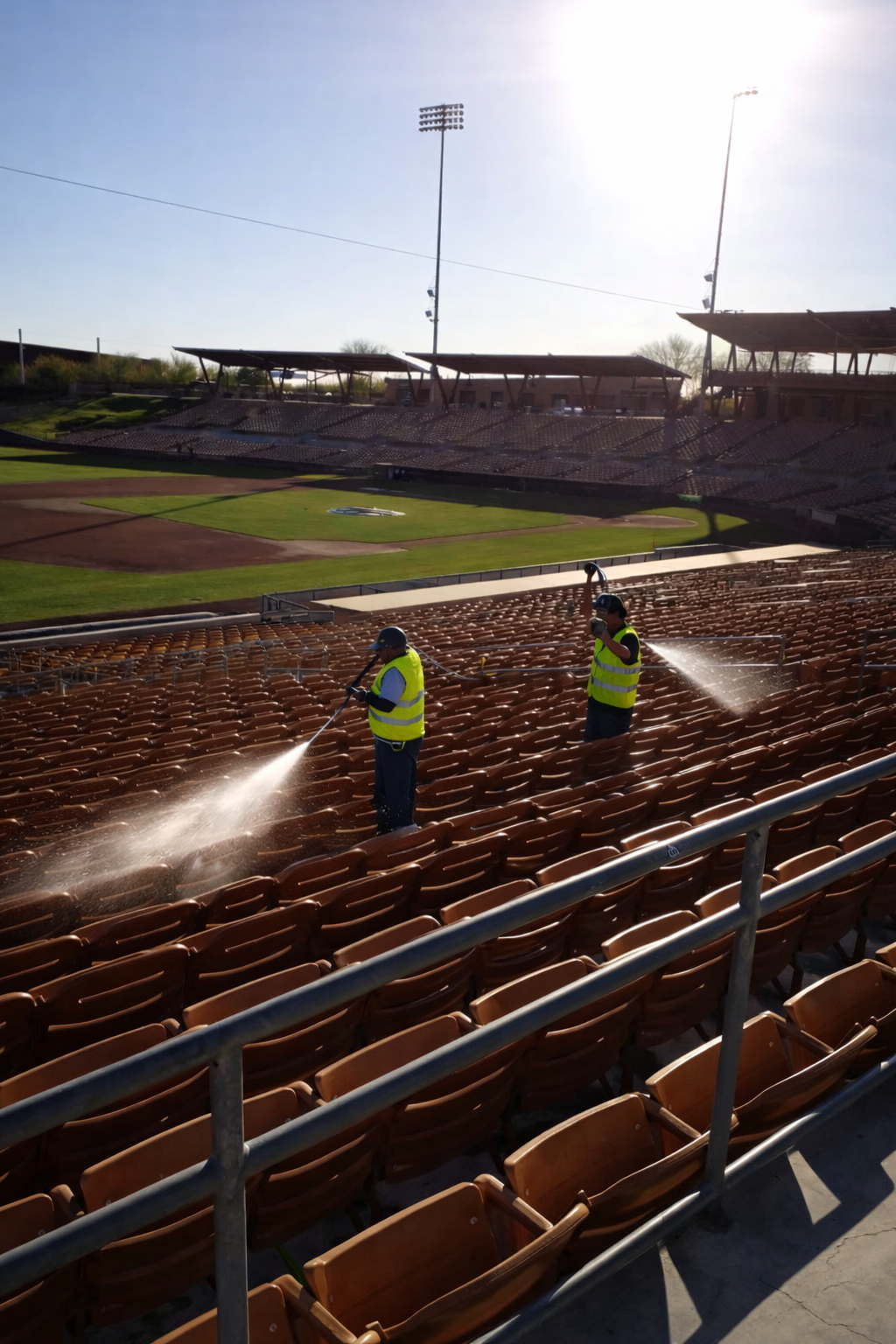
Hot-water pressure washing a Buckeye Arizona commercial stucco facade after haboob season

BUCKEYE CLIMATE REALITY

Why Buckeye Commercial Properties Face a Different Kind of Grime Problem

Most commercial cleaning conversations start with aesthetics. In Buckeye, they need to start with chemistry. Three forces shape what cleaning actually has to address on a property here, and ignoring any one of them lets damage compound while the building still looks fine.

The desert soils surrounding Buckeye’s developed corridors carry high concentrations of alkaline minerals. When dust from those soils settles onto stucco, concrete, or painted surfaces and goes through repeated wet-dry cycles, those minerals don’t just sit on top. They begin etching into porous materials. What looks like a surface film after one haboob season becomes a progressively harder-to-remove mineral bond after two or three. The cleaning cost goes up. The surface damage accumulates underneath.
Buckeye’s position at the edge of undeveloped High Sonoran Desert means that active construction in master-planned communities like Verrado, Tartesso, and Teravalis generates its own category of particulate. Grading and excavation from development sites adds construction dust to the natural dust load, compounding the challenge for established commercial properties nearby.
Buckeye is adding commercial square footage at a pace few cities match. When a tenant is evaluating a lease renewal or a customer is choosing between two service options on the same corridor, a grime-streaked entry or stained parking lot next to a freshly opened retail center doesn’t just look bad. It signals that the property is behind. A competitor’s cleaner building doesn’t need a lower rent to win that comparison.

BUCKEYE COMMERCIAL EXTERIOR CLEANING

Commercial Exterior Cleaning Services for Buckeye Properties

A property manager in Buckeye is rarely dealing with a single surface or a single building. A typical commercial portfolio here might include stucco-faced retail bays, concrete drive lanes running behind food-service tenants, decorative paver plazas visible from high-traffic residential streets, and parking lot walkways that shade-loving algae treats as a growth medium from October through April. Addressing the full exterior envelope, rather than spot-treating the most visible problem, is what keeps a property consistently presentable between service visits.

Building Washing

Stucco and painted CMU block dominate newer commercial construction throughout Buckeye, and both materials trap fine desert dust in their textured surfaces in ways that smooth cladding simply doesn’t. After haboob season ends in late September, building faces accumulate a season’s worth of alkaline sediment, oxidation streaking, and in shadier exposures, biological growth that spreads slowly under the surface. Left through the winter and into the following monsoon cycle, that combination hardens under UV exposure and becomes significantly more difficult to remove. The highest-urgency windows for building washing are post-monsoon in the fall, when the season’s damage is fresh and before it sets, and in the weeks before a new tenant opens, when first impressions are being established for an entire customer base.

Concrete Cleaning

The concrete surfaces on a Buckeye commercial property take a specific kind of punishment. Drive-through lanes at food-service locations accumulate grease drip. Loading dock aprons at logistics facilities develop oil staining from vehicle dwell time. Retail entry plazas collect tire scuff from high-volume parking lot traffic, and the post-storm alkaline mud that washes across flat surfaces bakes into a mineral residue that routine sweeping doesn’t address. Beyond appearance, shaded walkway sections develop algae growth that creates genuine slip hazards, a liability exposure that property managers in multi-tenant environments can’t afford to ignore. A stained, worn-looking concrete entry also sends a specific message to a tenant weighing a lease renewal: that deferred maintenance is the operating posture here.

Pressure Washing

Some contamination problems on a Buckeye commercial property go beyond what routine building or concrete washing addresses. A food-service tenant’s rear service pad builds up grease over months of kitchen operation. Decorative block or pavers near active irrigation heads develop mineral scale from repeated wet-dry cycles with hard desert water. A newly completed commercial space in one of Buckeye’s developing retail corridors needs post-construction surface prep before a tenant takes possession, removing stucco overspray, construction dust, and surface residue that can’t be walked past on opening day. In each of these situations, pressure washing delivers the higher-intensity, targeted cleaning the surface requires. The calibration matters here: the same stucco facades and decorative pavers that define Buckeye’s master-planned commercial aesthetics are also the materials most vulnerable to surface erosion from incorrect pressure settings. Professional assessment before each job is what keeps the cleaning from creating a new problem.

NEIGHBORHOODS & COMMERCIAL CORRIDORS

Buckeye Neighborhoods and Commercial Corridors We Serve

Buckeye’s commercial landscape spans a footprint large enough to contain several distinct markets within a single city. The retail environment along the Verrado Way interchange bears almost no resemblance to the industrial corridor running near the I-10 center, and neither looks like the legacy commercial strips around downtown. Property managers working across different parts of Buckeye are managing genuinely different building types, customer bases, and surface challenges. The following zones reflect where commercial exterior cleaning needs show up most distinctly.

The commercial properties along Verrado Way, anchored by the developing Verrado Marketplace and the retail pads clustered near the I-10 interchange, serve a community that was designed with a specific visual standard in mind. Verrado’s homeowners and regular visitors arrived expecting a certain aesthetic, and the commercial corridor that serves them is held to that same expectation.

For a retail center manager or franchise operator in this corridor, exterior presentation is not a background consideration. It is part of the value proposition. Stucco storefronts here are directly visible from residential streets with active pedestrian traffic. Decorative paver plazas in front of restaurants and service businesses are where customers form their first impression before they reach the door. A dust-coated facade after a haboob, or gum-spotted sidewalk concrete outside a food tenant, is noticed immediately in this environment, not just by the business’s customers but by neighboring tenants and residents walking past.

The Verrado corridor also sits close enough to undeveloped land to the west that dust events hit these properties with the same intensity as anywhere else in Buckeye, regardless of how intentionally the surrounding community was designed. That contrast between the community’s design standards and the realities of desert particulate is exactly why scheduled cleaning in this corridor tends to be more frequent than property managers initially plan for. A single post-monsoon cleaning gets the building back to baseline. Quarterly maintenance keeps it from slipping visibly between events in a location where the customer base notices.

Post-monsoon building washing, concrete cleaning on plaza entry surfaces, and decorative paver treatment are the most common recurring needs in this corridor, with urgency heightened whenever a new tenant is opening or a lease renewal conversation is approaching.

The stretch of commercial property running along Watson Road and into downtown Buckeye’s historic core along Monroe Avenue presents a different kind of challenge. This is where older building stock sits alongside active redevelopment, where a masonry storefront from a previous generation of Buckeye commerce is now being evaluated in the same visual field as newer mixed-use construction nearby.

Property owners and managers operating legacy commercial space in this corridor are navigating a revitalization dynamic that makes exterior appearance more consequential than it would be in a stable, uniform market. An older stucco or brick facade that might look characterful in an established historic district looks like deferred maintenance when it’s positioned against newly constructed neighbors. Grime, oxidation streaking, and biological growth on an older building face in this context amplifies the perception of age in ways that accelerate the visual gap between the legacy property and the newer stock.

Older masonry and porous stucco surfaces in the downtown corridor also hold staining longer than newer coated surfaces. Mineral deposits and biological growth penetrate more deeply into the substrate, which means the cleaning approach needs to match the surface, favoring lower-pressure, higher-dwell-time methods that lift contamination without eroding surface material that cannot be replaced easily. A professional surface assessment before each job is especially important here, where the wrong approach can leave the facade looking worse than the grime did.

For property managers in this corridor, the business case for regular exterior cleaning is also a repositioning argument. Keeping the building face, walkways, and entry concrete in consistent, maintained condition narrows the visual gap between their asset and the newer competition and keeps tenant and customer attention where it belongs, on the business inside the building.

The western reaches of Buckeye, including the Tartesso community and the emerging commercial nodes along Miller Road and the Broadway corridor, represent a different operational moment. Much of the commercial activity here is in the new-construction and pre-occupancy phase, where developers and property managers are preparing assets for their first tenants rather than maintaining properties already in use.

Post-construction cleaning in this corridor is a standard operational requirement, not an optional finishing detail. A commercial pad or retail bay that has just completed construction in Buckeye’s western desert carries a specific load of surface contamination: construction dust that has blown in from surrounding open land during the build phase, stucco overspray from facade work, concrete residue on approach surfaces, and the general particulate accumulation that happens when a building sits open on a construction site for months. A tenant walking a space before signing their lease, or arriving for their first day of operations, should not be navigating surfaces that still read as a construction site.

The Miller Road and Broadway corridor is also building out at a pace that means property managers here are often coordinating cleaning for multiple buildings simultaneously or in close succession. The operational priority is reliability, a cleaning crew that shows up when the project timeline requires and completes the work to a standard that survives a tenant walk-through, without needing to be called back.

As this corridor matures and transitions from new construction to active occupancy, the cleaning need shifts from post-construction prep to ongoing maintenance, particularly for properties that sit close to the undeveloped land to the west that generates the heaviest dust load in the city.

The neighborhood commercial properties clustered near the Sundance community and the Blue Horizons residential development in northern Buckeye serve a specific customer profile: active-adult and established residents with significant discretionary income and high expectations for the environments where they choose to spend it. Medical offices, personal service retail, specialty food, and professional services dominate this commercial mix, and the customers who use them are making decisions about which providers to return to based on a complete experience that starts in the parking lot.

A cracked, stained concrete entry or a building facade with visible grime streaks does something specific in this submarket. It doesn’t prompt a complaint. It prompts a quiet decision not to return. The customer in this demographic who notices a dirty entry doesn’t tell the property manager. They simply find a cleaner alternative the next time they need that service, and the operator loses a repeat customer without ever knowing the exterior was the trigger.

This dynamic is why properties serving the Sundance and Blue Horizons customer base benefit specifically from scheduled, recurring cleaning rather than reactive single-event cleaning. A once-a-year cleaning after a complaint or before an inspection resets the exterior to baseline but allows visible deterioration to accumulate in the months between. A quarterly or bi-annual scheduled program keeps the property consistently above the threshold that this customer base uses, however unconsciously, to evaluate whether a business is worth returning to.

Parking lot concrete, building entry surfaces, and building facades are the highest-priority surfaces in this submarket. The cleaning standard that matters here isn’t dramatic transformation. It’s the absence of anything that would give a careful, observant customer a reason to second-guess their choice.

COVERAGE AREA

Serving Buckeye and the Surrounding Area

Many commercial property managers overseeing assets in Buckeye also control properties in surrounding suburbs and nearby commercial corridors. Coordinating separate vendor relationships for each location creates scheduling friction, inconsistent results, and administrative overhead that adds up across a multi-site portfolio. A single cleaning partner with the equipment capacity and scheduling flexibility to serve properties across the broader service area simplifies that operational picture considerably. Whether the portfolio includes a handful of buildings in neighboring communities or a mix of assets spread across the broader region, consistent service standards and a single point of accountability make recurring maintenance easier to manage. The goal is the same at every location: surfaces that stay clean, tenants who notice the difference, and customers who never have a reason to look twice at the exterior before deciding to walk in.
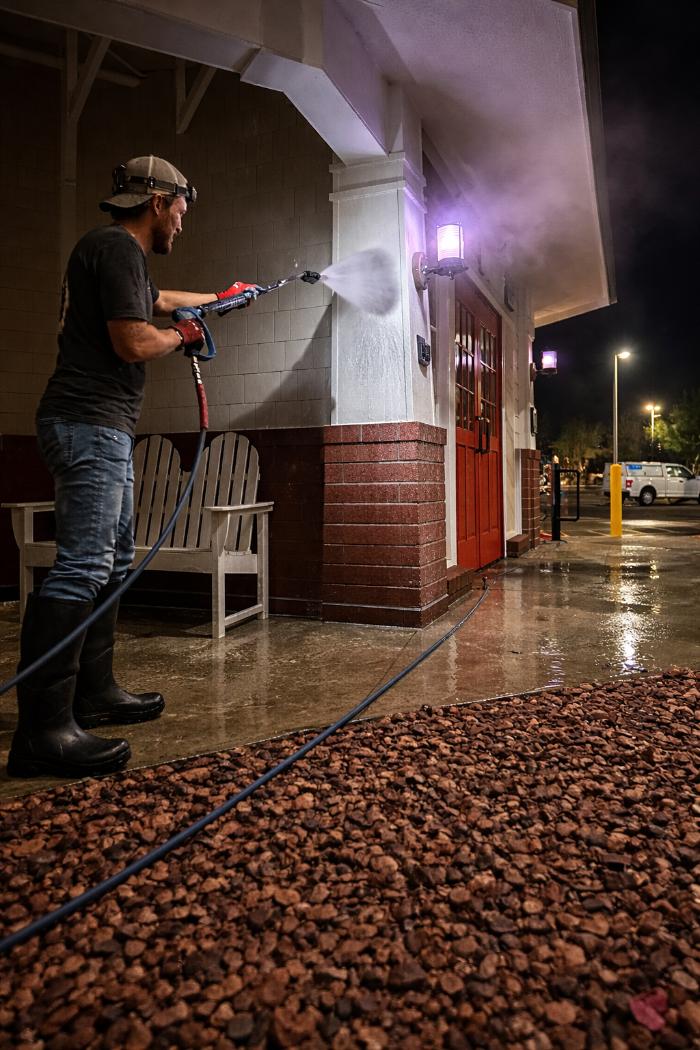
AZ Power Clean crew serving a Buckeye Arizona commercial property and surrounding metro service area

COMMON QUESTIONS

Frequently Asked Questions About Commercial Pressure Washing in Buckeye

Property managers setting up a recurring exterior maintenance program in Buckeye for the first time tend to arrive with similar questions. The specifics of this city’s environment, its haboob season, its alkaline soils, its newer building materials, and its regulatory requirements, shape what a good program actually looks like here.

For most Buckeye commercial properties, the minimum effective program includes a post-monsoon cleaning in the fall, after the June through September haboob season has deposited its full dust and mud load, and a spring cleaning ahead of peak foot traffic months. Food-service tenants with rear service pads, high-traffic retail entries, and properties adjacent to active construction should typically schedule more frequently. The goal is staying ahead of the mineral bonding cycle rather than reacting to visible buildup after it has set.
It does, and the mechanism is the alkaline mineral content in Buckeye’s desert soils. When that mineral-rich dust settles onto stucco, concrete, or painted surfaces and goes through multiple wet-dry cycles, the minerals begin etching into the porous substrate. What starts as a surface film becomes a progressively more embedded bond that requires more aggressive treatment to remove and, if left long enough, creates permanent surface etching. Addressing dust accumulation promptly, especially after heavy haboob events, keeps cleaning straightforward and prevents the cost and complexity from compounding.
Yes, when the service is calibrated correctly for the specific surface. The stucco facades and decorative pavers common in Buckeye’s master-planned commercial corridors are materials that respond well to professional cleaning but are vulnerable to damage from incorrect pressure settings. Too much pressure on stucco erodes the texture coat. On paver installations, incorrect technique can dislodge the sand binding the joints. A professional surface assessment before each job identifies the appropriate pressure level, nozzle type, and cleaning agent for the specific material, protecting the surface while delivering a thorough clean.
Commercial pressure washing generates contaminated wastewater that carries oils, sediment, biological material, and cleaning agents. State environmental guidelines require that this wastewater be prevented from entering the storm drain system, which in Buckeye’s case connects to natural desert wash drainage. Professional service providers manage this through surface containment, collection, and proper disposal practices that keep contaminated runoff out of the drainage system. When evaluating a cleaning contractor, confirming their wastewater containment approach protects the property manager from liability under local runoff regulations.
Scheduling flexibility is available specifically to avoid disrupting tenant operations or customer-facing hours. Early-morning starts, evening service windows, and off-peak scheduling can be arranged to keep cleaning activity off the property during peak customer hours or delivery windows. In multi-tenant retail or office environments, crews coordinate with the property manager ahead of each visit to address access conflicts, sequence work around tenant schedules, and ensure that drive lanes and entry areas are cleared and dry before business hours begin.

GET A FREE QUOTE

Ready to Keep Your Buckeye Commercial Property Clean Year-Round?

If exterior maintenance has been something you address reactively, after a tenant complaint, ahead of an inspection, or when the grime becomes impossible to ignore, this is a reasonable moment to ask whether a scheduled program would be easier and less expensive to operate. In Buckeye’s environment, reactive cleaning means you’re always starting from a worse baseline. Mineral deposits have had time to bond. Biological growth has had time to spread. The cleaning is harder, takes longer, and costs more than it would have two months earlier.

AZ Power Clean works with Buckeye property owners and managers to build scheduled exterior maintenance programs that match the specific demands of this city’s environment, from post-monsoon building washing to recurring concrete cleaning to post-construction surface prep in the city’s developing corridors. Get in touch to request a free quote for your Buckeye commercial property and start a conversation about what a year-round maintenance program looks like for your specific buildings.

Open 24 hours, Monday through Sunday. Family-owned, licensed, and insured. 100% satisfaction guarantee.
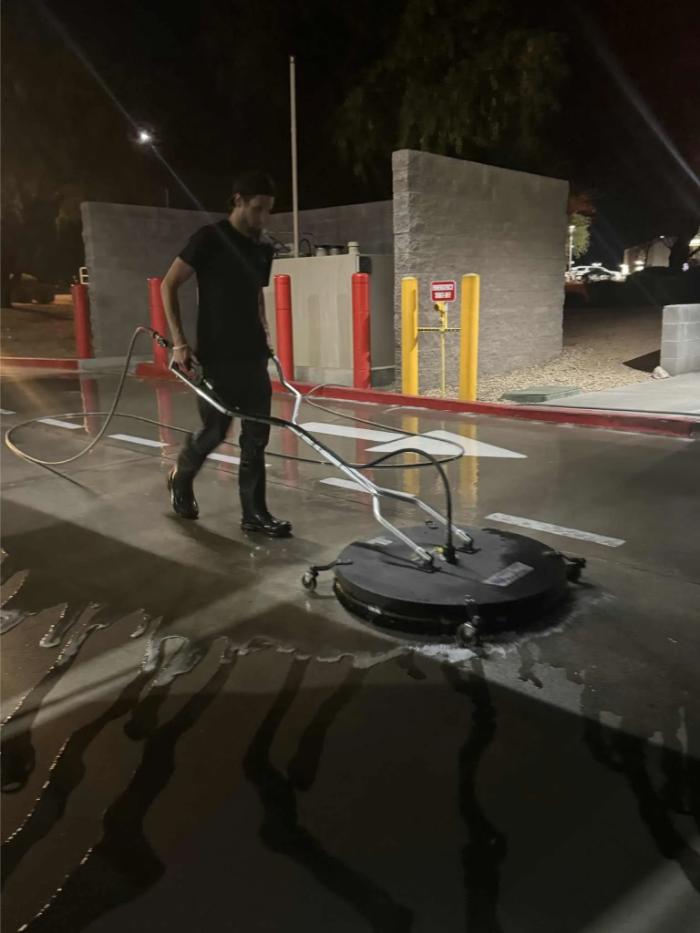
AZ Power Clean technician performing commercial exterior cleaning on a Buckeye Arizona property