Family-Owned, Licensed and Insured, Serving Scottsdale Since 2015

Commercial Pressure Washing in Scottsdale, AZ

You walk a building exterior in late October and the stucco tells the whole story. Three months of monsoon runoff have left pale mineral streaks down every vertical surface. The entry plaza concrete is ringed with caliche-toned deposits where pooled rainwater evaporated. The storefront glass, facing west, is clouded with hard water scale from morning sprinkler overspray that has cycled through wet and dry a hundred times since spring. In a city where a visitor’s first impression forms at the curb, not at the front desk, that building is already losing before anyone walks through the door. AZ Power Clean is a family-owned, licensed, and insured commercial exterior cleaning team operating in Scottsdale since 2015, equipped with hot-water pressure washing systems and available around the clock for scheduled maintenance and emergency response.
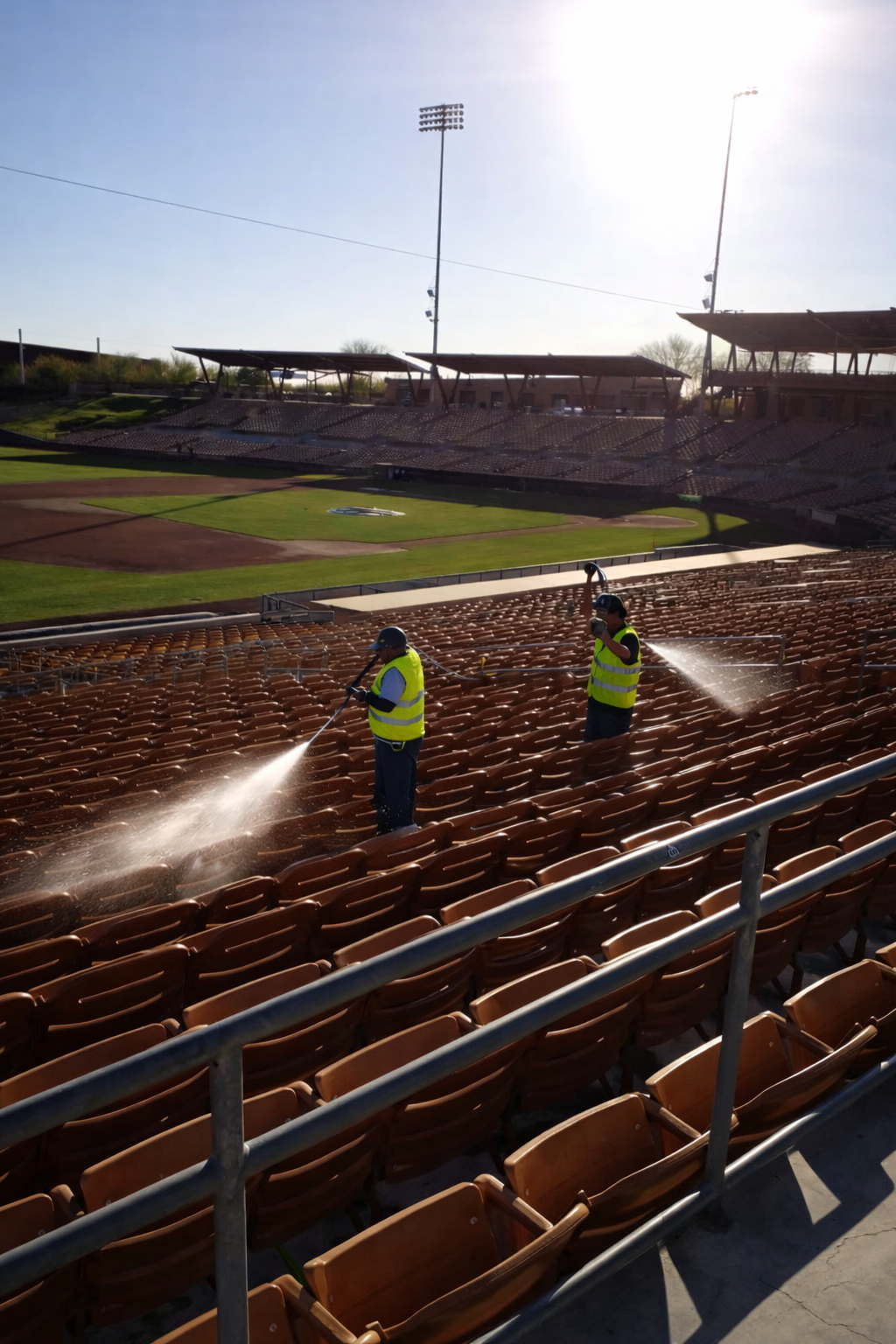
Hot-water pressure washing a Scottsdale commercial stucco facade with post-monsoon mineral streaking

SCOTTSDALE CLIMATE REALITY

Why Scottsdale’s Desert Climate Makes Commercial Exterior Cleaning Non-Negotiable

Three forces compound on every Scottsdale commercial exterior, and none of them pause between visits from your maintenance crew.

Sonoran Desert particulate is fine, wind-driven, and abrasive, working itself into the texture of stucco and sandblasted concrete during every dry-season wind event. Standard sweeping and rinsing push surface debris around. They do not pull embedded particulate out of the substrate, which is where the dull gray film actually lives.
Every sprinkler cycle that overshoots a planting bed and hits a concrete walk or a glass storefront leaves a calcium deposit behind. Left for one or two more wet-dry cycles, that deposit begins to harden and etch into the surface. By the time it is visibly white and crusty, it has already done measurable damage.
The July-through-September window drops heavy, fast-moving rain onto surfaces already loaded with dust. When the water evaporates, it leaves a streaked, clay-toned residue across stucco, concrete, and glass alike. By October, every unmanaged commercial surface in the city is carrying the record of a full storm season.

In a market where hospitality, upscale retail, and Class A office set the standard for what a property is supposed to look like, a facade encrusted with mineral deposits and post-monsoon staining does not read as weathering. It reads as neglect. And in Scottsdale, neglect gives high-value tenants and customers a reason to choose the building across the street.

SCOTTSDALE COMMERCIAL EXTERIOR CLEANING

Scottsdale Commercial Exterior Cleaning Services

A Scottsdale property manager overseeing a mixed portfolio faces a problem that compounds quietly. The sun is intense, the water is hard, the dust never fully stops, and the window between monsoon season and the peak winter visitor period is short. Each of the services below addresses a specific category of exterior cleaning demand that Scottsdale’s climate and building stock generate, across retail storefronts, Class A office, light industrial, and hospitality-adjacent properties.
Commercial Pressure Washing

Walk a Scottsdale stucco exterior in late October and what you find is not surface-level dirt. The monsoon has pushed suspended dust and minerals into the texture of the facade, where they have been baking under UV exposure since August. Hot-water commercial pressure washing at calibrated PSI levels for stucco pulls that embedded contamination out without eroding the finish. Pressure selection matters specifically here because Scottsdale stucco, particularly on older applications, does not tolerate the same approach you would use on concrete block. A post-monsoon wash completed before the dry winter months removes the residue that would otherwise continue to etch and degrade the surface through the high-UV season ahead.

Office Window Cleaning

For the facilities manager at an Airpark or North Scottsdale office building, the glass problem shows up in two ways. Tenants notice it first as dimmed natural light through floor-to-ceiling panels. Visiting clients notice it as a low-maintenance signal before they sit down for a meeting. What looks like a coating of dust on west-facing glass is often a combination of windblown particulate and mineral scale from irrigation overspray, accumulated through repeated wet-dry cycles. Professional window cleaning removes both, including the early-stage mineral etching that a squeegee alone cannot address. On a regular service schedule, it prevents the point where etching becomes permanent and glass replacement becomes the only corrective option.

Parking Lot Cleaning

A Scottsdale commercial parking area accumulates three distinct problem layers. Windblown sand and grit drifts into pavement cracks and low spots between monsoon events. Vehicle traffic at retail centers and Airpark business parks leaves oil drip patterns across drive lanes. Post-monsoon mud deposits settle into every low-flow area and harden as the surface dries. Together, they create a surface that communicates neglect to every arriving tenant or customer before they reach the front door. Beyond appearance, oil and grit buildup creates real slip-hazard liability on walkway approaches and parking deck ramps. Regular cleaning removes the accumulation before it bonds to the surface and before it creates conditions a property manager has to document after an incident.

Concrete cleaning a Scottsdale entry plaza with UV-baked organic staining at a restaurant pad

Concrete Cleaning Services

Scottsdale commercial concrete takes abuse that cooler climates do not generate at the same rate. Entry plazas, sidewalks, and dumpster pads sit under intense UV exposure all day. At restaurant pads, cooking grease contacts a surface that is already hot, which accelerates bonding into the substrate. At drive lanes, tire rubber transfers in ways that standard sweeping cannot reverse. The combination of heat, UV, and heavy organic loading means stains that might remain surface-level in other environments become embedded contamination in Scottsdale within a matter of weeks. Commercial-grade hot-water concrete cleaning reaches the bonded layer and restores a surface condition that routine maintenance was never designed to achieve.

Storefront pressure washing along an Old Town Scottsdale pedestrian retail corridor near 5th Avenue

Storefront Pressure Washing

In a pedestrian corridor like Old Town, or along a retail strip near Kierland Commons, the decision to walk into a business starts on the sidewalk. A storefront facade accumulates food and beverage residue from neighboring tenants, mineral scale from landscaping irrigation that hits glass panels, and monsoon-deposited grime at ground level that dries into a textured film. Each of those layers contributes to a visual signal that a potential customer reads in about three seconds. For the retailer competing against the business two doors down for the same foot traffic, a clean storefront is not a cosmetic preference. It is part of the competitive presentation that drives whether that pedestrian stops or keeps walking.

Industrial pressure washing at a Scottsdale Airpark warehouse loading dock with hydraulic fluid and dust contamination

Industrial Pressure Washing

The Scottsdale Airpark concentrates more than 2,900 businesses and more than 51,000 workers across 8.6 square miles of commercial and industrial real estate. At that density of operations, warehouse loading docks, equipment bays, and fleet vehicle areas accumulate grease, hydraulic fluid, and Sonoran Desert dust at a rate that creates both an image problem and a surface liability. Industrial-grade hot-water pressure washing is the appropriate method for dock pads and concrete aprons carrying heavy oil and fuel contamination, where lower-temperature equipment moves contamination around rather than emulsifying it. Scheduling matters as much as method in this environment. Early-morning or weekend service windows keep the work off the critical path of a tenant’s daily operations, which is the difference between a vendor an Airpark property manager can actually use and one they eventually stop calling.

NEIGHBORHOODS & COMMERCIAL DISTRICTS

Scottsdale Neighborhoods and Commercial Districts We Serve

Scottsdale’s commercial landscape is not uniform, and a cleaning plan that fits one district will not map cleanly onto another. A retail strip adjacent to Scottsdale Fashion Square operates under fundamentally different conditions than a light industrial campus in the Airpark, a resort-adjacent office corridor in the north, or a redeveloping commercial strip in the south. Each submarket generates its own exterior cleaning demands in terms of surface types, foot traffic patterns, and how quickly neglect becomes visible to the people who matter most.

Old Town’s commercial core is one of the densest pedestrian environments in the city. Storefronts along 5th Avenue, Main Street, and the blocks surrounding Scottsdale Fashion Square see continuous foot traffic seven days a week, with the volume climbing sharply during the October-through-May visitor season when tourists, diners, and hotel guests fill the sidewalks for months at a stretch. For the property manager or retail tenant operating here, the cleaning calendar is driven by that rhythm. A post-monsoon wash in October lands just before the pedestrian season peaks. A spring service before summer heat sets in addresses the accumulation from the visitor months.

But the pace of surface degradation in Old Town is faster than in lower-traffic districts. Storefront glass picks up drink spills and food residue from the restaurant-heavy tenant mix on every block. Entry plaza concrete stains within weeks of a post-monsoon cleaning if it is not maintained on a regular schedule. Ground-level facades accumulate a combination of windblown Old Town dust and pedestrian-level residue that no amount of periodic sweeping removes. The competitive reality here is specific: every business on a given block is competing for the same pedestrian decision. A clean storefront in a corridor where a competitor’s storefront is also clean is table stakes. A dirty storefront in that same corridor is a visible liability that costs the retailer foot traffic it will never know it lost.

The Scottsdale Airpark is not a secondary commercial zone. It is one of the largest employment centers in the state, with more than 2,900 businesses operating across 8.6 square miles and a workforce that exceeds 51,000 people. The facilities directors and property managers working here are dealing with commercial real estate at a scale and professional image standard that has no room for deferred exterior maintenance. A Class A office campus whose glass facades are visibly coated in mineral deposits tells the story of a property management team that is not paying attention. That story reaches tenant decision-makers before lease renewal conversations do.

The cleaning challenges in the Airpark are layered. Warehouse and flex-space loading bays accumulate diesel exhaust residue, tire rubber, and oil contamination on concrete aprons in ways that get ahead of any standard maintenance plan within a few months. Office glass facades face mineral deposit buildup from the irrigation systems that keep the landscaped perimeters presentable. Parking structures shared by large tenant rosters need cleaning on a schedule that cannot interfere with the arrival and departure windows of thousands of employees daily. Flexibility in scheduling is not a convenience in this environment. It is a hard requirement. A vendor that can only work standard business hours during the week will consistently create operational disruptions for Airpark tenants, which is why early-morning, weekend, and after-hours service windows are part of how this district’s properties get managed effectively.

The mixed-use corridor anchored by Kierland Commons and Scottsdale Quarter sets one of the highest presentation bars in the city. The tenant mix here includes national retailers, fine dining concepts, boutique hospitality, and resort-adjacent services catering to a clientele with high expectations for the environment they are shopping and dining in. For the retail center property manager or landlord operating in this corridor, the exterior cleaning standard is set by the tenants themselves, who have brand image standards written into their leases and the foot traffic data to measure when presentation slips.

The surface challenges here are specific to the format. Polished and scored concrete common areas in open-air retail environments show every monsoon stain and every scuff from delivery vehicle tires in a way that a plain-broom concrete surface would partially mask. Storefront glass fronting a walkway where guests are pausing, sitting, and spending time needs to be genuinely clean, not just rinsed. Shared parking decks carry the reputational weight of every tenant in the center; a dirty deck signals to an arriving guest that the property is not well-run before they have even parked. A proactive maintenance schedule built around the visitor season calendar (heavier service in fall before October traffic peaks, maintenance intervals through the spring) gives a property manager in this corridor the ability to hold the standard their tenants require without reacting to visible problems after the fact.

The McDowell Road Corridor in South Scottsdale is in an active period of commercial transformation. The SkySong innovation campus has anchored a wave of redevelopment that has brought tech employers, creative agencies, and mixed-use projects into a corridor where legacy commercial stock has been sitting for decades. The property managers working along this stretch are dealing with two parallel realities. Older stucco and concrete buildings carry years of compounded mineral deposits, vehicle exhaust staining, and deferred surface maintenance that require more aggressive cleaning cycles just to reach a presentable baseline. Newer buildings and freshly finished retail pads on the same block need a fundamentally different approach, one focused on protective maintenance that preserves the finish rather than remediation that restores it.

The exterior cleaning challenge this creates is a sequencing problem as much as a surface problem. A property manager overseeing multiple buildings at different stages of the redevelopment arc needs a vendor who can calibrate the approach building by building rather than applying a single method across the portfolio. The practical benefit of a single-vendor relationship in this corridor goes beyond logistics. It means the team already knows the surface profile of each building in the portfolio, which walls carry old mineral intrusion and which concrete pads need preventive service rather than corrective cleaning. That institutional knowledge shortens the planning cycle for each service visit and removes the friction of re-explaining the property to a new crew every season.

COVERAGE AREA

Serving Scottsdale Properties and the Surrounding Service Area

A facilities director managing a Scottsdale commercial portfolio often oversees buildings that extend beyond the city limits into surrounding suburbs and neighboring communities. Managing a separate vendor relationship for each geography adds administrative overhead and introduces inconsistency in service standards across buildings that the same tenants and clients visit. The same team and equipment serving Scottsdale’s commercial accounts can extend to outlying properties in the broader service area, so a property manager with a portfolio that spans multiple submarkets has a single point of contact regardless of which address needs service. Consistent methods, consistent crews, and consistent documentation across the full portfolio means the property manager is not reconciling different service levels when they review maintenance records. The relationship scales with the portfolio.
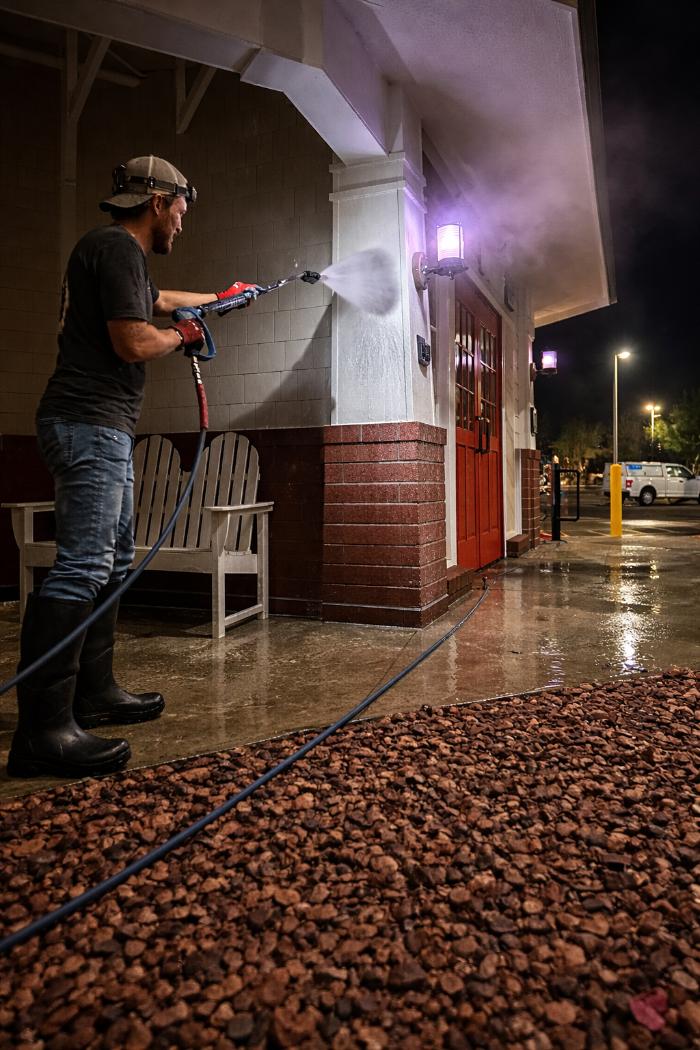
AZ Power Clean crew serving a Scottsdale commercial property and surrounding metro service area

COMMON QUESTIONS

Frequently Asked Questions: Commercial Pressure Washing in Scottsdale

Scottsdale’s two-season exterior cleaning rhythm gives most properties a useful baseline: a post-monsoon service in October after the storm season’s surface damage has settled, and a pre-summer service in spring before visitor-season foot traffic peaks. High-traffic retail properties in Old Town or along major retail corridors typically need more frequent intervals than that. Office and light industrial properties in the Airpark often operate effectively on quarterly or semi-annual cycles depending on how much tenant-facing exterior exposure the building carries.
Sonoran Desert particulate is fine, wind-driven, and abrasive. It embeds into textured stucco and sandblasted concrete at a structural level that organic or petroleum-based grime in wetter climates does not. Hot-water pressure washing at PSI levels calibrated for each specific surface type is necessary to pull embedded desert dust without abrading the finish. A standard cold-water rinse moves surface debris but does not address the embedded layer where the visible dullness actually originates.
Surface damage from pressure washing comes from applying incorrect pressure to the wrong substrate. Professional work begins with an assessment of the surface, including identifying hairline cracks, areas of moisture intrusion, or prior finish inconsistencies in stucco, before equipment settings are chosen. A crew that skips that assessment and applies a default pressure setting is the source of most stucco damage claims. A responsible approach treats each Scottsdale property’s surface condition as the starting point for every service decision.
Summer scheduling is practical when work is planned during early-morning hours, before surfaces reach peak temperature and before ambient heat accelerates water evaporation to the point where it affects the cleaning process. Hot-water equipment remains effective in high ambient temperatures, but heat, pavement temperature, and the rate at which solution dries on a surface all factor into how a Scottsdale commercial job is sequenced in July or August. Timing the work appropriately makes summer service viable rather than problematic.
Monsoon season is not a pause in the need for exterior cleaning. It is the period that generates some of the most specific and damaging surface conditions of the year. Post-storm deposits on concrete surfaces can resemble caliche in texture and mineral content. Mineral streaking on glass and stucco from evaporated storm runoff sets quickly under Scottsdale’s post-monsoon heat. A cleaning appointment in October, after the last storm has passed and surfaces have dried, is one of the highest-value service events on the annual calendar for any Scottsdale commercial exterior.

GET A FREE QUOTE

Ready to Keep Your Scottsdale Property Clean Year-Round?

The dust season, the monsoon, and the winter visitor period each put their mark on a Scottsdale commercial exterior in sequence, and the window between the end of storm season and the start of peak foot traffic is shorter than it looks on the calendar. AZ Power Clean has been completing commercial exterior cleaning jobs in Scottsdale since 2015, working across retail storefronts, office campuses, industrial facilities, and mixed-use properties throughout the city.

If your property is due for a post-monsoon wash, a pre-season service before peak visitor months, or anything in between, we can schedule a walk-through and provide a no-obligation quote for the work.

Open 24 hours, Monday through Sunday. Family-owned, licensed, and insured.
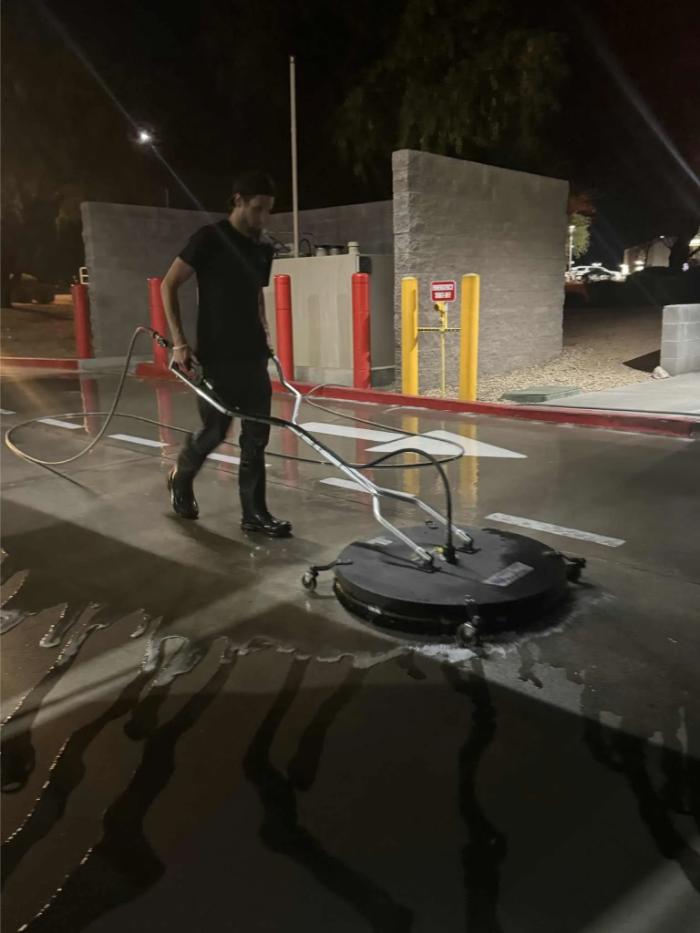
AZ Power Clean technician performing commercial exterior cleaning on a Scottsdale property